Architecture
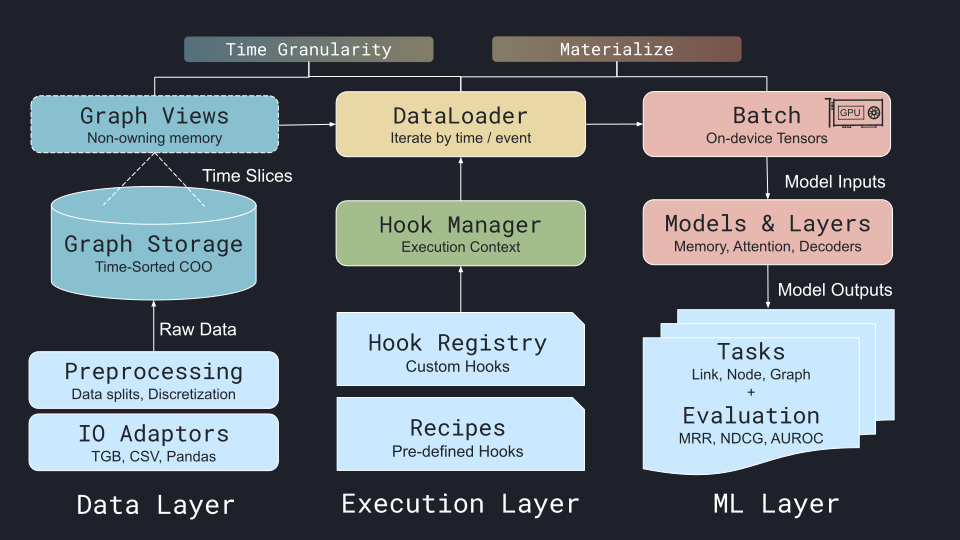
TGM is organized as a three-layer architecture:
-
Data Layer
-
Immutable, time-sorted coordinate-format graph storage with lightweight, concurrency-safe graph views.
- Efficient time-based slicing and binary search over timestamps, enabling fast recent-neighbor retrieval.
- Supports continuous-time and discrete-time loading, with vectorized snapshot creation.
-
Extensible backend allows alternative storage layouts for future models.
-
Execution Layer
-
The DataLoader is responsible for iterating through the temporal graph data stream by time or events based on the user-defined granularity.
- HookManager orchestrates transformations during data loading (e.g., temporal neighbor sampling), dynamically adding relevant attributes to the Batch yielded by the dataloader.
- Hooks can be combined and registered under specific conditions (analytics, training, etc.).
-
Pre-defined recipes simplify common setups (e.g. TGB link prediction) and prevent common pitfalls (e.g., mismanaging negatives).
-
ML Layer
-
Materializes batches directly on-device for model computation.
- Supports node-, link-, and graph-level prediction.
[!TIP] Check out our paper for technical details.